
About the event
Introduction
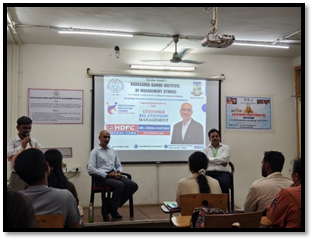
MMBGIMS Marketing Committee organised a guest session on Customer Relationship Management on 6th March 2026 . Mr. Vishal Kapoor VP of Marketing at HDFC Mutual Fund, a seasoned professional from HDFC Bank, conducted an engaging session on Customer Relationship Management (CRM) with a focus on profitability, customer segmentation, and the evolving role of AI in managing customer relationships. The session challenged conventional thinking around customer loyalty and profitability.
- Core Theme: The Equation of CRM
The central argument of the session was built around a fundamental yet often misunderstood equation in business:
“Loyalty does NOT always equal Profit”
Companies often make the mistake of rewarding loyal customers without evaluating whether those customers are profitable. Mr. Kapoor used several real-world examples to illustrate this point:
Case Studies & Examples
| Company | CRM Insight |
| Amazon Prime | A customer buying a ₹500 phone case and returning it post-use causes a net loss to Amazon. Such customers appear loyal but erode profitability. |
| Zomato | Frequent users of Zomato dine-in promotions may seem loyal but may not generate sufficient margin to justify retention costs. |
| Air India (Maharaja Club) | Points and rewards are selectively awarded to the most profitable members, not merely the most frequent flyers. |
| Uber vs Ola | Uber detects when a user has also opened the Ola app and proactively offers better deals to retain that customer in real time. |
| Shoppers Stop | The First Citizen loyalty programme offers exclusive early access to sales and personalised shopping assistants, converting high-loyalty, high-profit customers into brand ambassadors. |
The CRM Profitability-Loyalty Matrix
Mr. Kapoor presented a strategic 2×2 matrix plotting customers on two axes: Profitability (Y-axis: Low to High) and Loyalty (X-axis: Low to High). Each quadrant defines a distinct customer segment requiring a unique management strategy.
| Quadrant | Customer Type | Characteristics & Strategy | Example |
| Q1 (High Profit / Low Loyalty) | Butterflies | Profitable but not loyal. Exploit them in the short term; do not over-invest in retention. | Occasional high-value shoppers |
| Q2 (High Profit / High Loyalty) | True Friends | Most valuable segment. Invest in deepening the relationship; these are the ideal customers. | Shoppers Stop First Citizen members |
| Q3 (Low Profit / Low Loyalty) | Strangers | Neither loyal nor profitable. Minimise costs; do not invest in retention. | Retired individuals using bank branches for minor transactions.
Starbucks, for instance, does not necessarily try to retain every customer. |
| Q4 (Low Profit / High Loyalty) | Barnacles (Leeches) | Loyal but drain resources. Manage carefully; reduce service costs or gently disengage. | Airtel/Tanishq customers are using excessive support time |
Strategic Implication: The goal is to identify which quadrant a customer occupies and act accordingly.
- The Marketing Funnel & CRM
The speaker also connected CRM to the marketing funnel, explaining how customer data at each stage helps optimise engagement:
- TOFU (Top of Funnel): Awareness — attracting new prospects
- MOFU (Middle of Funnel): Interest & Desire — nurturing leads through personalised communication
- BOFU (Bottom of Funnel): Action — converting leads into customers
- Post-Purchase: Resale & Retention — using existing customer data to drive repeat purchases
Key insight: CRM data makes it far easier and cheaper to convert existing customers at the resale stage compared to acquiring new ones through TOFU or MOFU efforts.
AI’s Role in CRM
During the Q&A session, students enquired about how AI is transforming CRM. Mr. Kapoor highlighted the following:
- AI enables real-time analysis of customer behaviour — e.g., HDFC Bank uses AI to analyse repayment patterns, loan history, and CIBIL scores to customise product offerings for each customer.
- AI can identify True Friends and Butterflies with high accuracy using transaction data, app usage, and behavioural signals.
- AI supports dynamic pricing and personalised offers — as demonstrated by Uber’s real-time competitive response to Ola app usage.
- Without data, AI is meaningless. Data integrity and quality are prerequisites for any AI-driven CRM strategy.
Key Takeaways
Mr. Kapoor summarised the session with four foundational principles for effective CRM:
- Loyalty and profitability are not the same — a loyal customer can still be a loss-making one.
- Companies must know their customers well enough to make strategic retention decisions.
- Every customer segment requires a differentiated strategy — there is no one-size-fits-all approach.
- Poor tracking leads to rewarding the wrong customers, resulting in financial losses.
“The goal of CRM is not to keep every customer — it is to keep the right customer.”
Skills Required for CRM in the AI World
Mr. Kapoor outlined the key competencies students should develop to build careers in CRM:
| Analytical & Technical Skills | Soft Skills |
| • Analytical thinking
• Problem solving • Data interpretation • CRM tools (e.g., HubSpot) |
• Communication
• Decision making • Patience • Practical exposure & application |
Conclusion
| “The goal of CRM is not to keep every customer — it is to keep the right customer.”
— Mr. Vishal Kapoor, HDFC Bank |
Feedback
The feedback from participants was highly positive. Students appreciated the seminar’s depth, clarity, and practical orientation. Many expressed that the session enhanced their knowledge about CRM.
The guest session was organised by the Marketing Committee and effectively contributed to achieving PSO 1, which focuses on developing students’ entrepreneurial skills and employability to meet the future requirements of industry and society.